Every commercial property in the United States operates under a fire code — a detailed body of regulations that dictates everything from sprinkler specifications to how far your fire extinguishers can be from a kitchen hood. Fire code compliance is the ongoing work of meeting those regulations, documenting your adherence, and maintaining them as standards evolve.
Done right, compliance protects lives, lowers insurance premiums, and keeps your operation running without interruption. Done poorly — or not at all — it results in fines that can exceed $10,000 per day, forced closures, insurance non-renewals, and in the worst cases, criminal liability.
This guide explains what fire code compliance actually means in 2026, who enforces it, what it requires, and — critically — how to treat compliance as an ongoing system rather than a one-time event.
What Is Fire Code Compliance?
Fire code compliance is the ongoing process of meeting all fire safety regulations set by your local Authority Having Jurisdiction (AHJ). For commercial businesses, it's not a one-time event — it's a continuous system that protects lives, assets, and your license to operate.
In practice, compliance means three things working together:
- Physical conformity — your building, fire protection systems, and operations meet the current fire code adopted in your jurisdiction.
- Documentation — you can prove compliance with inspection tags, test records, drill logs, and evacuation plans when an AHJ inspector asks.
- Ongoing maintenance — you continue to meet requirements as codes evolve, tenants change, and systems age.
Fire inspections are the most common form of compliance verification. If you're unsure what those involve, start with our detailed guide to fire inspection requirements.
Compliance is enforced through a layered system:
- International Fire Code (IFC) — the model code adopted (with amendments) by most US states
- NFPA 1 (Fire Code) — an alternative model code used by some states, and the parent standard for hundreds of technical requirements referenced by both codes
- State adoption — each state adopts a specific edition with its own amendments
- Local AHJ enforcement — your city or county fire marshal enforces the state code, sometimes with additional local provisions
The result: compliance is nationally framed, state-modified, and locally enforced. Understanding this layered reality is the first step to staying compliant.
Who Needs to Comply?
Virtually every non-residential building in the United States must comply with the adopted fire code. The most heavily regulated occupancies include:
- Assembly — restaurants, theaters, event venues, places of worship, nightclubs
- Educational — K-12 schools, daycares, colleges, training centers
- Healthcare — hospitals, nursing homes, ambulatory surgery centers, outpatient clinics
- Institutional — correctional facilities, detention centers
- High-hazard — chemical storage, flammable liquid facilities, industrial manufacturing with combustibles
- Mercantile — retail stores, shopping centers, supermarkets
- Business — offices, professional services, co-working spaces
- Residential (3+ units) — apartments, hotels, dormitories, assisted living
- Storage and industrial — warehouses, logistics hubs, manufacturing plants
Single-family homes are generally exempt from ongoing operational fire inspections, but must comply with building-code fire safety provisions at the time of construction or major renovation.
A common misconception: small businesses think they're exempt because they're small. They're not. A 1,200-square-foot coffee shop is subject to the same fire code as a 50,000-square-foot warehouse — the requirements scale with occupancy type, not just size.
The Two Primary Fire Codes: NFPA 1 vs. IFC
Most fire code confusion starts here — and most businesses never bother to understand it. You should.
The United States doesn't have a single federal fire code. Instead, two organizations publish competing model codes that states adopt with amendments:
International Fire Code (IFC)
- Published by the International Code Council (ICC)
- Adopted by most US states (approximately 42 states use IFC as the base)
- Revised on a 3-year cycle (current edition typically IFC 2024 for states adopting recent versions)
- Designed to integrate with the full family of I-Codes (International Building Code, International Plumbing Code, etc.)
NFPA 1 (Fire Code)
- Published by the National Fire Protection Association (NFPA)
- Adopted by a minority of states (including Massachusetts and a handful of others)
- Revised on a 3-year cycle
- References hundreds of other NFPA standards (NFPA 13 for sprinklers, NFPA 72 for alarms, NFPA 25 for inspection/testing/maintenance)
What matters for your business
Even in IFC states, many technical requirements are delegated to NFPA standards. Your sprinkler system is governed by NFPA 13. Your fire alarm is governed by NFPA 72. Your extinguisher schedule follows NFPA 10. The IFC sets the framework, but NFPA standards dictate most of the specifics.
This is why a compliant building in California (IFC-based) and a compliant building in Massachusetts (NFPA-based) look remarkably similar — the underlying standards are largely shared. What differs is the top-level code structure, enforcement philosophy, and state-specific amendments.
Bottom line: you don't need to memorize which code your state uses. You need to know that your local AHJ is enforcing a specific edition with specific amendments, and that your compliance work must match that edition.
Core Requirements of Fire Code Compliance
Every commercial property, regardless of occupancy type, must address the same core pillars of compliance. The specifics vary — a warehouse and a hospital have different thresholds — but the categories don't.
Means of egress
- Exits clearly marked, illuminated, and never obstructed
- Minimum number of exits based on occupant load
- Travel distance from any point to an exit within code limits
- Panic hardware on required doors
- Emergency lighting with 90-minute battery backup
Fire protection systems
- Automatic sprinkler systems (when required by occupancy or size) per NFPA 13
- Fire alarm and detection systems per NFPA 72
- Portable fire extinguishers per NFPA 10 (travel distance typically 75 feet or less)
- Standpipes in buildings over 3 stories or above certain square footage
- Commercial kitchen hood suppression per NFPA 96
Fire-rated construction
- Fire-resistance ratings for walls, floors, and ceilings based on occupancy
- Fire doors that close and latch properly
- Proper firestopping at penetrations through rated walls
- Fire dampers in HVAC ducts crossing rated assemblies
Testing, inspection, and maintenance (ITM)
- Quarterly, annual, and 5-year sprinkler inspections per NFPA 25
- Annual fire alarm testing per NFPA 72
- Monthly visual checks and annual maintenance on extinguishers per NFPA 10
- Kitchen hood suppression inspections every 6 months per NFPA 96
- All inspection records preserved and available for AHJ review
Hazard management
- Proper storage of flammable and combustible liquids
- Hot work permits for welding, cutting, and brazing
- Compressed gas cylinder handling and storage
- Housekeeping standards — storage distances from sprinkler heads, clear aisles, electrical panel clearance
Operational practices
- Fire safety and evacuation plan on file and communicated to staff
- Fire drills (required in schools, healthcare, and high-rise occupancies)
- Assembly occupancy load postings
- Training for key staff on alarm response and evacuation
Documentation
- Current inspection tags on all fire protection equipment
- ITM records organized and accessible
- Fire drill logs (where required)
- Evacuation plans and floor diagrams
- Hot work permit records
Getting all seven categories right, consistently, over years — that's compliance. Missing any one of them puts you at risk.
State-Level Variations That Affect Compliance
Fire code compliance is national in framework and local in execution. The same NFPA 72 fire alarm requirement is enforced differently in Los Angeles than in Houston, because each state has adopted a different edition of the IFC (or NFPA 1) with its own amendments.
Key variations to know:
- California — operates under the California Fire Code (CFC) and Title 19 CCR, with amendments for wildland-urban interface zones and strict seismic considerations for fire protection systems.
- Texas — adopts the IFC through the State Fire Marshal's Office, with significant local amendments in major metros (Dallas, Houston, Austin, San Antonio).
- Florida — uses the Florida Fire Prevention Code under Chapter 633 F.S., with hurricane-specific considerations for fire protection system anchoring.
- New York — uses the Fire Code of New York State, with the NYC Fire Code providing additional stringent requirements for five-borough properties.
- Illinois — enforced by the Office of the State Fire Marshal, with Chicago Building Code integration and Cook County amendments.
We maintain detailed state guides with specific requirements, common enforcement issues, and local nuances for each of the following:
If your state isn't listed, your starting point is your local fire marshal's office — they can tell you which edition of which code applies and what local amendments exist.
The Cost of Non-Compliance
The business case for compliance isn't just about avoiding fines — it's about understanding what happens when a single violation cascades.
Direct regulatory costs
- Administrative fines — typically $100 to $1,000 per violation per day. Some jurisdictions assess $10,000+ daily for life-safety violations or repeat offenders.
- Re-inspection fees — most AHJs charge $100-$500 per re-inspection visit, and they pile up if you don't correct violations promptly.
- Violation remediation — the actual work to fix the underlying issue, which ranges from $200 for a tag replacement to $50,000+ for sprinkler system upgrades.
Indirect costs (often larger than the direct ones)
- Insurance premium increases — carriers routinely raise premiums 15-40% after a documented fire code violation. Some decline to renew entirely.
- Insurance claim denials — if a fire occurs while you're out of compliance, your claim can be denied, leaving you personally liable for losses.
- Lease and mortgage complications — many commercial leases include fire code compliance clauses. A violation can trigger default provisions.
- Operational shutdown — for imminent hazards, AHJs have statutory authority to order occupants out until the hazard is corrected. Every hour of closure is lost revenue.
Worst-case costs
- Criminal liability — rare, but possible for willful violations resulting in injury or death
- Civil liability — lawsuits from tenants, customers, or employees harmed in a fire that occurred during non-compliance
- Business closure — for some jurisdictions, chronic non-compliance can result in revocation of your business license
For a detailed breakdown of the most frequently cited violations and how to resolve them quickly, see Fire Code Violations: What They Are and How to Fix Them.
How to Achieve and Maintain Compliance
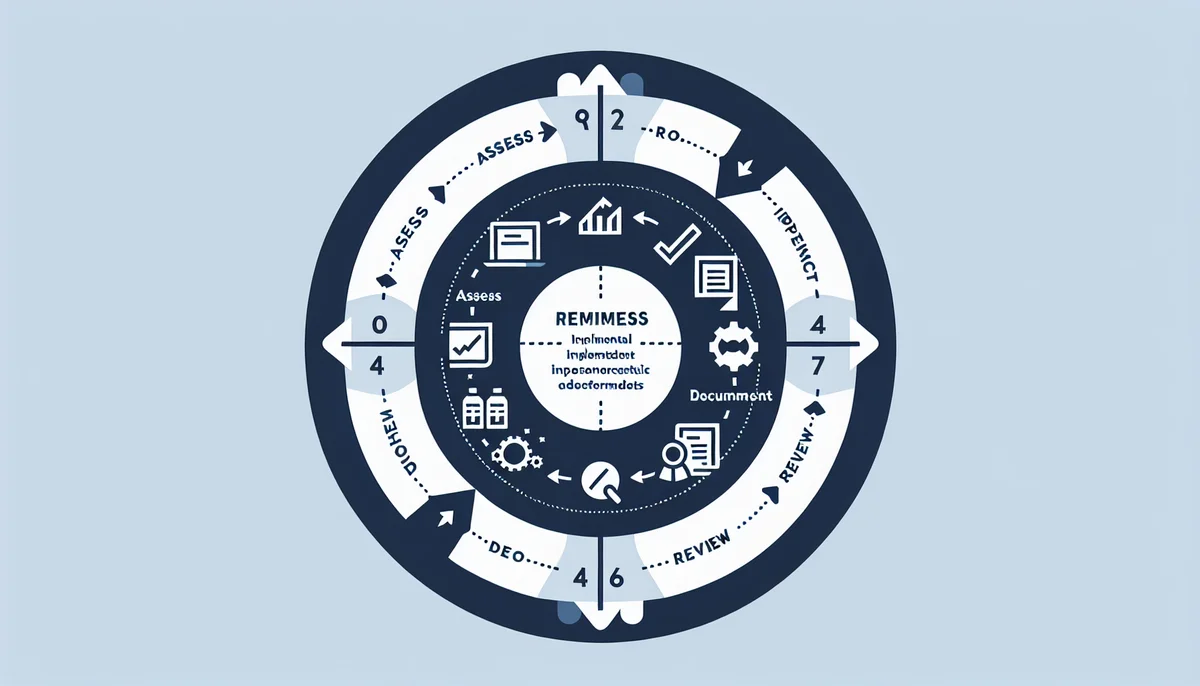
Compliance isn't a project with an end date. It's a four-stage cycle that repeats continuously. If your business treats it as a one-time checklist, you'll fail an inspection within 18 months.
Stage 1: Assess
Before you can be compliant, you need to know where you stand. An honest assessment includes:
- Identifying your occupancy classification under IFC or NFPA 1
- Confirming which edition of which code your AHJ has adopted
- Reviewing your building's fire protection systems and their inspection status
- Auditing operational practices (drills, hot work, housekeeping)
- Identifying gaps between current state and required state
Many businesses skip this step and jump straight to fixing what seems obvious. They end up fixing the wrong things, or fixing things in the wrong order. The assessment is cheap compared to the cost of misdirected effort.
Before your next inspection, use our printable Fire Inspection Checklist as a self-audit starting point.
Stage 2: Implement
Close the gaps identified in Stage 1. Priority order:
- Life-safety violations first — blocked exits, disabled alarms, missing sprinkler coverage
- Documentation gaps next — expired tags, missing inspection records, outdated evacuation plans
- Housekeeping and operational — storage clearance, electrical panel access, extension cord misuse
- Long-term upgrades last — system modernizations, occupancy-type changes, major renovations
Stage 3: Document
Undocumented compliance is, for all practical purposes, non-compliance. AHJ inspectors work from records. If you can't show it, it didn't happen.
Essential documentation:
- All fire protection system inspection and testing records (5 years minimum, longer for some jurisdictions)
- Fire drill logs (where required)
- Hot work permits
- Fire safety and evacuation plan with last-review date
- Training records for staff who handle fire safety responsibilities
- Any AHJ correspondence, permits, or variance approvals
Digital records are acceptable in most jurisdictions. A shared folder with dated, organized files is sufficient — but don't rely on a single person's email inbox.
Stage 4: Review
Fire codes change. Your building changes. Your tenants change. Your operations change. Without regular review, compliance drifts.
Annual review checklist:
- Confirm your jurisdiction hasn't adopted a new code edition
- Verify all inspection tags are current
- Re-audit operational practices
- Review the fire safety plan for changes (new equipment, new procedures, new staff)
- Schedule the next year of required inspections
Businesses that run this four-stage cycle reliably rarely fail inspections. Businesses that don't — reliably do.
Common Compliance Mistakes Businesses Make
We've seen hundreds of failed inspections. The same mistakes appear again and again.
1. Treating compliance as a one-time event
The most common mistake. A business passes an inspection, declares victory, and doesn't look at fire safety again for two years. By the next inspection, drift has accumulated across every category.
2. Assuming their landlord handles it
Many commercial leases assign fire code compliance to the tenant, not the landlord, even for building-wide systems. Read your lease. Most operators discover this only after a violation notice.
3. Expired inspection tags
An alarm or sprinkler system can be physically perfect and still fail inspection because its tag expired three months ago. Inspectors read tags first.
4. Storage within 18 inches of sprinkler heads
Sprinklers need air circulation around them to work. Pallets, boxes, or inventory stacked too high block the spray pattern. This is the single most common warehouse violation.
5. Blocked or locked exits
Often unintentional — a pallet temporarily parked in front of an exit during restocking, an exit door chained “for security.” Both trigger immediate citations.
6. Extension cords used as permanent wiring
Extension cords are for temporary use only. When a business routes a computer, printer, or appliance via extension cord for weeks or months, that's a violation regardless of the load.
7. Electrical panel clearance violations
Fire code requires 36 inches of clear space in front of every electrical panel. Supply closets that grow into storage rooms are the usual culprit.
8. Missing fire safety and evacuation plan
Every commercial occupancy needs one. Many have a plan on file from 2019 that references staff who no longer work there.
9. Improper handling of flammable liquids
Paint thinners, cleaning chemicals, cooking oils — stored in wrong cabinets, without proper ventilation, or in quantities exceeding permitted limits.
10. No hot work permits
Any welding, cutting, or brazing in a commercial space requires a hot work permit. Contractors routinely skip this step, and the business owner gets the citation.
See our full reference: Fire Code Violations: The 2026 Guide.
When to Work with a Compliance Consultant
Some businesses handle compliance in-house with a competent operations manager. Others need expert help. The question is when the second approach pays off.
Work with a consultant when:
- You've received a notice of violation and don't understand the specific code section cited
- You're opening a new location and need a compliance roadmap before occupancy
- You operate across multiple states and need consistency
- You've failed an inspection twice in a row
- You're considering a renovation that may trigger upgraded compliance requirements
- You lack the internal bandwidth to run the four-stage cycle above
- You're being sold services by vendors and want an independent second opinion
A licensed fire protection consultant costs $500-$3,000 for an initial assessment in most markets. Compared to the average cost of a single significant violation ($5,000-$50,000 in fines, fixes, and indirect costs), it's cheap insurance.
Handle it in-house when:
- Your operation is simple (single location, low occupancy, no hazardous materials)
- You have a competent operations or facilities manager with fire safety training
- Your AHJ is responsive and educational rather than adversarial
- You've passed inspections cleanly for three consecutive cycles
Most commercial businesses fall somewhere in between, and a hybrid approach works well: handle routine items in-house, bring in a consultant annually for review or for new initiatives.