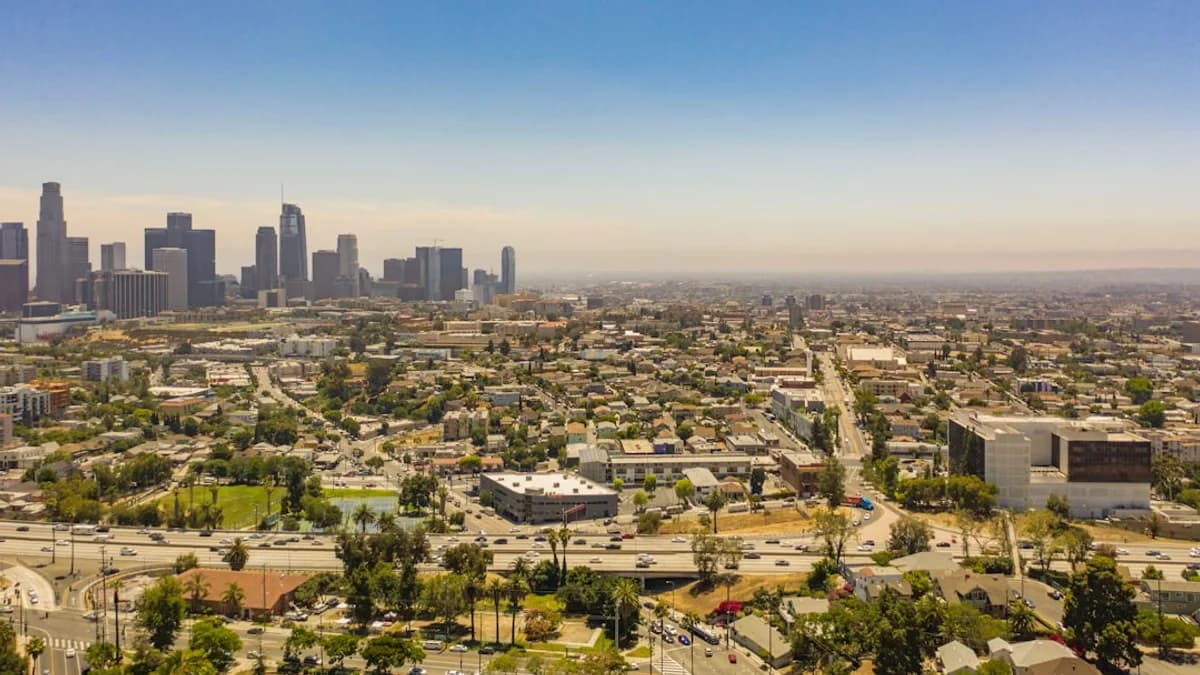
Los Angeles enforces fire code at a level of institutional depth that few cities in the United States match. The Los Angeles Fire Department (LAFD) operates a dedicated Industrial and Commercial Section responsible for annual inspection of every high-rise in the city, a separate Fire Development Services Unit that reviews fire and life safety systems for over 10,000 buildings annually, and a Brush Clearance Program covering the Very High Fire Hazard Severity Zone — a program no other US city operates at comparable scale.
Understanding LA’s structure matters because commercial property compliance here is not a single-track process. You may be subject to annual inspection by the Industrial and Commercial Section, plan review by Fire Development Services, ongoing compliance reporting through the Brycer Compliance Engine, and brush clearance requirements if your property touches the VHFHSZ. Each track has its own timeline, documentation standard, and enforcement consequence.
This guide covers who inspects what, the LA-specific ordinances that go beyond California Fire Code, compliance reporting requirements, and the common violations LAFD cites across LA’s commercial building stock.
LAFD Structure and
What They Enforce.
Los Angeles Fire Department's fire prevention activities are distributed across multiple specialized units, each with defined jurisdiction. Knowing which unit you're dealing with clarifies what compliance actually looks like.
Industrial and Commercial Section
The Industrial and Commercial Section has inspection responsibility for all high-rise buildings within the City of Los Angeles on an annual basis. This section also inspects complex and large industrial and commercial occupancies, enforcing fire life safety regulations across the city's densest commercial footprint.
Additional responsibilities include:
- Enforcing ordinances covering brush and hazardous vegetation management
- Providing assistance and technical information to field personnel and the public
- Administering the annual Brush Clearance Program contract for private vendors
Contact: lafdciu@lacity.org
Fire Development Services
Fire Development Services is responsible for interpreting and enforcing the fire protection and life safety provisions of Titles 19 & 24 of the California Code of Regulations concerning new construction and remodels. This unit:
- Reviews fire and life safety systems for over 10,000 buildings annually
- Conducts pre-development meetings, plan reviews, permit approvals, and field inspections
- Coordinates with the Department of Building and Safety on alternate methods of construction
- Operates three office locations:
- Metro Office (by appointment): 201 N. Figueroa St., Suite 300, LA 90012, (213) 482-6900
- West LA Office: 1828 Sawtelle, 2nd Floor, LA 90025
- Van Nuys Office (by appointment): 6262 Van Nuys Blvd., 2nd Floor, Van Nuys 91401, (818) 374-5005
Hydrants and Access Unit
Reviews plans to evaluate site access and hydrant placement — critical for commercial properties with complex access requirements.
CUPA / CalARP Programs
For facilities handling hazardous materials, LAFD operates the Certified Unified Program Agency (CUPA) and California Accidental Release Prevention (CalARP) programs. CalARP facilities are inspected at least once every three years to determine compliance with CalARP Program regulations. Non-compliance triggers:
- Notice of Violation (informal enforcement)
- 30-day re-inspection window
- Formal enforcement if non-compliance continues — including administrative orders, civil referrals, or criminal referrals
LAMC 91.8604 —
LA-Specific Fire Safety Standards.
Beyond the California Fire Code, Los Angeles enforces LAMC (Los Angeles Municipal Code) Section 91.8604 — a city-specific ordinance establishing fire safety standards for existing commercial and industrial buildings. This is enforced through Fire/Life Safety Orders that carry significant consequences for non-compliance.
Key provisions:
- LAMC 91.8604.6 — Minimum requirements for buildings with occupancy above the first floor
- Fire Safety Standards Repair Orders — issued when LAFD inspection identifies non-conformance. Directs owner to repair and modify building to meet minimum requirements, submit plans, obtain permits, complete corrections
- Extension periods — owners may request time extensions (one year initial, renewable for two additional one-year periods) with a submitted plan of action
- Vacate orders — if owner fails to comply with orders within specified timeframes, LAFD may order the building vacated
- Demolition authority — after 90 days of ordered vacancy without corrective action, LAFD may order demolition under LAMC Division 89
This ordinance-level enforcement authority is significant. In most California jurisdictions, fire code violations lead to fines and re-inspections. In Los Angeles, persistent non-compliance with LAMC 91.8604 can ultimately result in building demolition ordered by the fire department.
The Compliance Engine (Brycer)
Reporting Requirement.
Los Angeles is one of the most prominent US jurisdictions requiring third-party Compliance Engine reporting for fire protection system testing.
What the requirement covers
All entities conducting test, retest, and unable-to-test reports for commercial high-rise buildings (75 feet or greater) operating within LAFD jurisdiction are required to submit those reports via the Brycer Compliance Engine.
Non-high-rise properties continue to submit reports as directed by their assigned Fire Inspector — typically via email to the relevant LAFD unit.
Practical implications
- The fee for Brycer participation is neither regulated nor collected by the City of Los Angeles
- LAFD cannot exempt or waive agencies from the requirement
- Email submissions to lafdhru@lacity.org for high-rise reports are no longer accepted — all must go through Brycer
- Contractor/servicing companies bear compliance responsibility, but building owners face ultimate accountability if reports are not filed
This third-party reporting model has been a source of friction for LA commercial operators — particularly those managing multi-property portfolios — because of the fee structure and additional layer between them and LAFD. Operators should expect Brycer participation as a cost of doing business in LA high-rise compliance.
Brush Clearance Program —
Unique to LA.
Los Angeles operates a commercial-scale Brush Clearance Program no other major US city matches. Under LAMC Section 57.1.603.5, LAFD administers the City's Defensible Space/Brush Clearance Program within the Very High Fire Hazard Severity Zone.
Inspection cycle for 2026
- Inspections scheduled to begin May 1, 2026
- Compliance due date: May 1, 2026
- Inspection-related bills mailed beginning August 2026
Fee schedule for non-compliance
- Initial Inspection (Pass): No fee
- Initial Inspection (Fail): $31.00 Brush Initial Inspection Fee
- Second Inspection (Pass): $31.00 Brush Initial Inspection Fee only
- Second Inspection (Fail): $31.00 + $758.00 Non-Compliance Fee
- Parcels failing both inspections: $1,740.00 Administrative Cost Fee + Contractor's Lowest Bid Price + $31.00 + $758.00 — property cleared by City contractors and billed to owner
- Late payment penalty: 200% of assessed amount
Palisades fire exemption: Parcels affected by the 2025 Palisades fire may be exempt from the $31.00 fee. Non-compliant exempt parcels still receive Notice of Non-compliance with correction deadlines.
Compliance responsibility: Maintaining property in accordance with LAMC 57.1.603.5 is due by May 1 and is a year-round responsibility. A single annual clearing often does not maintain compliance — vegetation grows back. Operators with multiple parcels in VHFHSZ should establish regular (not annual) vegetation management cycles.
FIMS —
Fire Inspection Management System.
LAFD operates a public-facing portal for inspection management: inspect.lafd.org.
What FIMS does:
- Property owners and managers can request inspections by entering Transaction ID and Street Name
- Access secured information about annual brush inspections
- View inspection status (compliance or non-compliance)
- Review R1/R2 Inspection Record identifying areas of focus for upcoming inspections
Registration requires APN and PIN (printed on annual brush clearance notifications from LAFD).
For brush clearance specifically: fims.lafd.org (separate portal for brush-related compliance tracking)
Common Violations in
LA Commercial Properties.
LAFD's most frequently cited violations reflect the city's specific enforcement structure.
1. Missing or deficient high-rise system testing reports in Brycer — contractors or property owners failing to submit required reports through the Compliance Engine. Results in ongoing compliance deficiency that can escalate.
2. LAMC 91.8604 fire safety standards non-compliance — older commercial buildings with occupancy above the first floor failing to meet minimum fire sprinkler, fire alarm, emergency power, or stairwell ventilation requirements.
3. Brush Clearance Program failures in VHFHSZ — commercial properties in the Very High Fire Hazard Severity Zone allowing vegetation to exceed compliance standards. $758 non-compliance fee + $1,740 admin fee + contractor cost stack quickly.
4. Hot work permits missing — construction-heavy LA commercial environments frequently cite for welding, cutting, or brazing without required permits.
5. Flammable and combustible liquid storage violations — common in restaurants, auto repair, industrial occupancies; LAFD CUPA tracks closely.
6. Fire door propping — fire-rated doors held open with wedges or tape. LA enforcement is aggressive given fire-spread investigation findings.
7. Storage height clearance below sprinkler deflectors — 18-inch minimum under Title 19. Inspectors measure.
8. Emergency lighting and exit sign failures — battery-backed fixtures degraded; push-to-test verification required. Without it, fixtures appear functional under normal power but fail during power loss.
For a comprehensive self-audit checklist covering these violations and more, see our fire inspection checklist or download the California-specific version (which LA operators should use, as it includes Title 19 and CFC items relevant to LAFD inspections).
Planning a New Build, Renovation,
or Change of Use in LA.
Commercial construction or substantial renovation in Los Angeles triggers LAFD Fire Development Services review. Expected workflow:
Step 1 — Pre-development meeting. For complex projects, schedule meeting with Fire Development Services case manager. Addresses alternate methods of construction, unusual materials, and compliance strategy.
Step 2 — Application for Plan Check. Submit through FIMS at inspect.lafd.org with complete fire and life safety documentation.
Step 3 — Plan Review. Fire Development Services reviews for California Fire Code, Title 19, Uniform Building Code, City, and National codes compliance. Correction notices issued for deficiencies.
Step 4 — Hydrants and Access Review. Separate evaluation of site access and hydrant placement.
Step 5 — Permit issuance. After plan approval and correction resolution.
Step 6 — Field inspections. During construction, LAFD field inspectors verify installed systems meet approved plans.
Step 7 — Final inspection + occupancy. LAFD sign-off required before Certificate of Occupancy.
Operators should budget 60-120 days minimum for LAFD plan review on standard commercial projects. Complex high-rise or hazardous materials projects can take 6+ months with pre-development meetings.
Los Angeles compliance questions, answered.
Quick answers to what commercial operators ask most about Los Angeles fire code compliance.
Other city guides in this state
Sacramento
Sacramento FD · State Capital Area