
A fire code violation notice lands on your desk, and it's easy to read it as catastrophe. Fines scaling by the day. Inspectors returning. Insurance carriers finding out. Operations interrupted.
The reality is less dramatic — if you respond correctly in the first 72 hours. Fire code violations are a normal part of running a commercial property. Fire marshals issue thousands every week. What separates an operator who pays $500 and moves on from one who pays $50,000 and spends six months fighting a closure order isn't luck. It's the response protocol.
This guide is that protocol. It covers the 12 most common violations you'll face, what they actually cost, how to resolve them in four clear steps, when to appeal versus comply, and — most importantly — how to prevent repeat citations that escalate fast.
What Is a Fire Code Violation?
A fire code violation is a formal citation issued by your local Authority Having Jurisdiction (AHJ) — typically the fire marshal's office — documenting that your commercial property fails to meet one or more requirements of the adopted fire code.
In practice, a violation notice is a document that states:
- What code section was violated — cited by chapter and section number from IFC, NFPA 1, or the state-specific code
- Where the violation exists — a specific location in your building (exit corridor, kitchen hood, electrical panel area)
- What condition triggered the citation — what the inspector observed
- What's required to come into compliance — the corrective action needed
- The timeline to correct — typically between 7 and 60 days, depending on severity
- The consequences of non-compliance — fine amounts, reinspection fees, possible escalation
Violations vary in severity. The AHJ categorizes them in three tiers:
- Imminent hazard — life-safety violations requiring immediate correction, often same-day. Examples: blocked exits, disabled fire alarm, sprinkler system out of service.
- Major violations — significant code failures requiring correction within 7-30 days. Examples: expired inspection tags, missing fire extinguishers in required locations, storage too close to sprinkler heads.
- Minor violations — administrative or housekeeping failures with correction windows of 30-60 days. Examples: outdated evacuation plan, missing fire drill log entry, blocked electrical panel.
Violations are the enforcement side of the broader compliance system. If your building runs a proactive compliance program, violations stay rare. For the framework behind ongoing compliance, see our guide to fire code compliance.
What to Do in the First 72 Hours After Receiving a Notice
The first 72 hours after receiving a violation notice are disproportionately important. Decisions you make in this window determine whether the violation stays minor or escalates into something much larger.
Hour 0-6 — Read the notice carefully.
Not skim — read. Identify:
- The exact code section cited (not just “fire code violation”)
- The corrective action required (not just “fix the issue”)
- The correction deadline
- Whether it's classified as imminent, major, or minor
- Any fine amount already assessed
Misreading the notice is the most common first-24-hour mistake. Operators assume they understand the citation and act on incomplete information.
Hour 6-24 — Document the current condition.
Photograph the cited issue from multiple angles with a timestamp. This creates your baseline — if the condition changes, you want evidence of what it was when cited.
Gather any existing documentation that relates: past inspection reports, maintenance records, vendor contracts for the system involved. You'll need these for resolution.
Hour 24-48 — Verify whether the citation is correct.
This sounds unusual — of course the fire marshal is right. Except fire marshals are humans making judgment calls, sometimes on ambiguous code language. An experienced fire code consultant can tell you within an hour whether the citation is:
- Clearly correct (most common)
- Technically correct but with available variances or exceptions
- Based on a debatable interpretation of the code
- Incorrect due to inspector error (rare but not unheard of)
The answer determines your path. See Section 7 for when to appeal versus comply.
Hour 48-72 — Start the correction or begin the appeal process.
If comply: schedule the corrective work, book the reinspection, notify stakeholders (tenants, insurance, lender if a mortgage covenant applies).
If appeal: file the formal appeal (most jurisdictions give 10-30 days), continue the correction process in parallel in case the appeal fails.
Operators who stay passive in the first 72 hours get worse outcomes — not because the fire marshal is punishing them, but because every additional day compounds reinspection fees, possible fine escalation, and documentation gaps.

The 12 Most Common Fire Code Violations
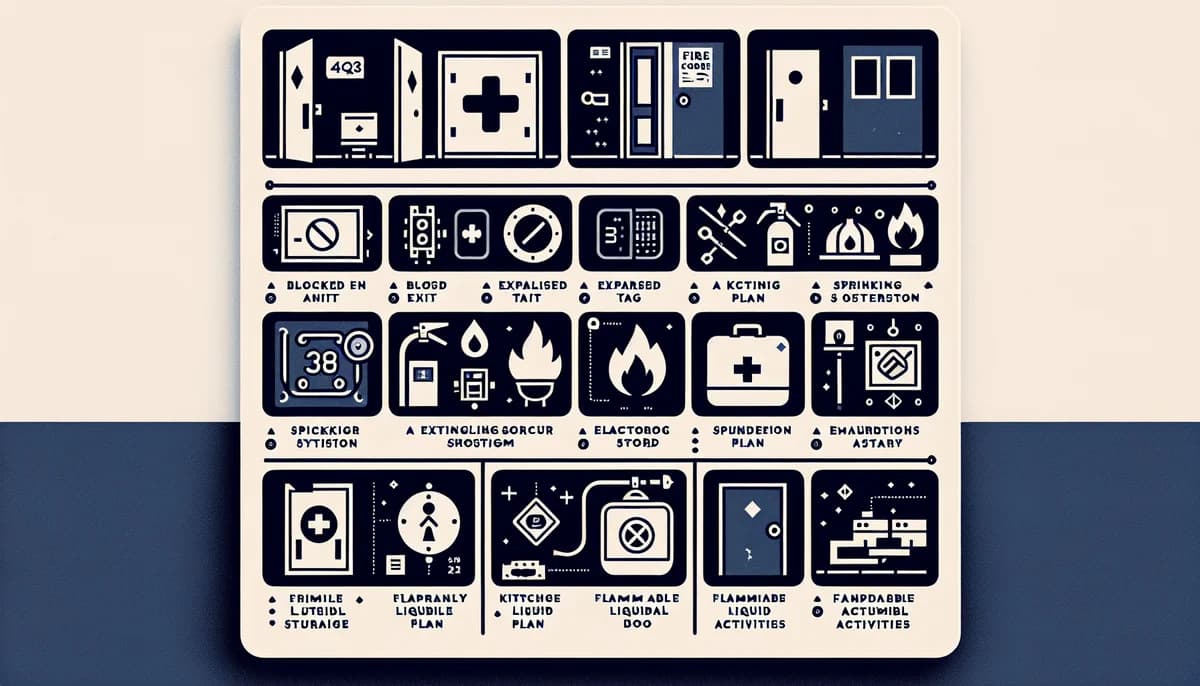
Across hundreds of thousands of annual citations in the US, the same violations appear again and again. Knowing them by name is the first step to both resolving and preventing them.
1. Blocked or locked exits
The single most cited violation across commercial properties. An exit door chained for security, a pallet temporarily parked in front of an exit, a storage rack that migrated into the exit corridor. Imminent hazard classification — corrections are same-day.
2. Expired inspection tags on fire protection equipment
Your sprinkler system, fire alarm, fire extinguishers, and kitchen hood suppression all carry inspection tags with dates. An expired tag — even if the system itself is functioning — results in a citation. Typical correction window: 14 days.
3. Obstructed or disabled fire alarm systems
Signage blocking a pull station, a sounder covered with tape, a panel displaying a trouble signal for weeks. Imminent hazard when the system is functionally impaired.
4. Improper storage near sprinkler heads
Sprinklers require at least 18 inches of clearance below the deflector. Pallets stacked higher block the spray pattern. The single most common warehouse violation. Major classification; 14-30 day correction.
5. Missing or improperly mounted fire extinguishers
Fire code requires specific extinguisher types, rated capacities, mounted at specific heights (typically no higher than 5 feet to the top), spaced so that no occupant is more than 75 feet from one (75 feet maximum for Class A hazards). Missing extinguishers, wrong type, or improper mounting all trigger citations.
6. Extension cords used as permanent wiring
Extension cords, power strips, and multi-tap adapters serving a permanent load (a refrigerator, a computer, a cash register) is a violation regardless of the electrical load. Correction is replacement with permanent wiring or approved relocatable power taps.
7. Blocked electrical panels
Fire code requires 36 inches of clear space in front of every electrical panel. Storage closets that grew into the electrical room are the usual source. Major classification.
8. Kitchen hood suppression failures
Commercial kitchens need hood suppression systems inspected every 6 months per NFPA 96. Missing inspection, grease buildup, or damaged nozzles all trigger citations — and kitchen violations carry escalation risk because of the fire probability.
9. Missing or outdated fire safety and evacuation plan
Every commercial occupancy needs a current fire safety and evacuation plan on file. Plans that reference staff who no longer work there, or rooms that have been renovated, are functionally absent.
10. Improper storage of flammable or combustible liquids
Paint thinners, cleaning chemicals, cooking oils stored in wrong cabinets, above permitted quantities, or without proper ventilation. Common in maintenance areas, janitorial closets, commercial kitchens.
11. Missing or damaged fire-rated construction elements
Fire doors propped open with wedges. Penetrations through rated walls for cabling, never properly firestopped. Fire dampers missing from HVAC ducts crossing rated assemblies. These are often long-standing conditions inherited from prior tenants.
12. No hot work permit for welding, cutting, or brazing
Any hot work in a commercial occupancy requires a permit issued by the AHJ or the facility's own hot work program. Contractors routinely skip this. The building owner gets the citation.
If you want to catch these before the inspector does, use our Fire Inspection Checklist as a self-audit tool.
Fire Code Violation Fines: What You'll Actually Pay
Fine structures vary by jurisdiction, but the patterns across the US are consistent enough to plan around.
Direct fine ranges
Minor violations — typically $100 to $500 per citation. Administrative matters, first-offense minor issues, documentation gaps. Often waived or reduced if corrected promptly.
Major violations — typically $500 to $2,500 per citation. Significant code failures affecting life-safety systems. Fines can be per-day for each day the violation persists past the correction deadline.
Imminent hazard violations — typically $1,000 to $10,000+ per citation, often with daily accrual. Some jurisdictions assess $10,000+ daily for life-safety violations affecting occupant egress or fire protection.
Repeat violations — escalate automatically. Most jurisdictions double the fine for the same citation at the same property within 12 months, and triple it on a third occurrence.
The fines that surprise operators
Direct fines are predictable. The surprise costs come from three sources most people don't anticipate:
Reinspection fees — after correction, the AHJ returns to verify. Most charge $100-$500 per reinspection visit. If you don't correct completely the first time, each return visit adds another fee. Three reinspections on a stubborn citation can add $1,500 to the total cost.
Fine accrual during appeal — if you appeal a violation and lose, most jurisdictions assess fines retroactively back to the original citation date, not the appeal ruling date. A 60-day unsuccessful appeal on a $500/day violation becomes a $30,000 fine.
Remediation cost — the fine is only the regulatory cost. The actual corrective work — new extinguisher system, sprinkler upgrade, fire-rated door replacement, hot-work permit compliance program — often costs 5-20x the fine itself.
Worst-case financial exposure
The highest-cost scenarios involve:
- Multiple simultaneous violations from a single inspection (inspectors rarely find just one thing)
- Life-safety citations that escalate to occupancy shutdown orders
- Insurance non-renewal following a documented violation pattern
- Civil liability if a fire occurs while the property was out of compliance
A property with a clean compliance record that receives its first minor citation is looking at $500-$2,000 in total cost. A property with a chronic pattern that ignores citations is looking at $50,000-$500,000 in escalated exposure.
How Violations Are Discovered and Cited
Understanding how violations reach you — not just what they are — helps you predict and prevent them.
Scheduled annual inspections. The most common source. Your local fire marshal schedules a formal inspection (usually annual, sometimes more frequent depending on occupancy). If you want to understand exactly what's reviewed during one of these, see our guide to fire inspection requirements.
Complaint-driven inspections. A tenant, employee, neighbor, or customer files a complaint with the fire marshal's office. The inspector visits — often without advance notice — and documents whatever they observe. Violations found during complaint inspections are often unrelated to the original complaint.
Pre-occupancy and certificate-of-occupancy inspections. New tenants, new construction, or change-of-use triggers inspection before the space can be legally occupied. Violations here block occupancy until resolved.
Post-incident inspections. After any fire or fire-related incident, even if minor, the fire marshal may return to inspect. Violations found here carry additional weight because they can be linked to the incident.
Insurance-driven inspections. Some commercial insurance carriers require fire safety inspections as a condition of coverage. Violations found may not generate government fines but can trigger premium increases or non-renewal.
Self-reported or consultant-discovered violations. Rarely cited formally, but worth knowing: if you discover a violation during internal audit or consultant review, the resolution process is similar but without the regulatory timeline pressure. Proactive resolution is always cheaper than reactive.
The inspector's job during any citation event is to document condition, not to train you. Don't expect detailed coaching — the notice tells you what, not how. That's your responsibility to figure out.
How to Resolve a Violation in 4 Steps
Resolving a fire code violation is a structured process. Follow these four steps in order — skipping any of them reliably produces worse outcomes.
Step 1: Understand the exact citation
Read the notice. Identify the specific code section cited. If the notice says “NFPA 1 Section 14.8.1” or “IFC 315.3,” look up that exact section. Don't rely on the inspector's paraphrase. Your obligation is to the code language, not the summary.
If the language is ambiguous or you can't find the section, call the AHJ office. Most will clarify over the phone within a day. Don't guess.
Step 2: Scope the corrective work
With the specific code requirement in hand, scope what's actually needed to come into compliance. This is where technical expertise matters most. A licensed fire protection consultant or specialized contractor can identify:
- The minimum corrective action that satisfies the code
- Whether a variance or alternative means is possible (sometimes cheaper)
- The full materials and labor cost
- The likely timeline to complete
Getting the scope wrong — either under-scoping and failing reinspection, or over-scoping and spending unnecessarily — is the most expensive Step 2 mistake.
Step 3: Execute the correction and document everything
Hire the qualified contractor or handle the corrective work in-house if appropriate. Throughout:
- Photograph the work in progress and completed
- Keep all receipts, work orders, and contractor certifications
- Have the contractor issue a written completion statement referencing the code section
- Update your internal compliance records
Undocumented correction is, for regulatory purposes, unverified correction. Inspectors on reinspection want paper, not stories.
Step 4: Schedule and pass the reinspection
Contact the AHJ to schedule the reinspection. Most allow this immediately after corrective work is complete. Have your documentation ready for the inspector.
On the reinspection, the inspector verifies the specific cited issue has been corrected. If it has, the violation is closed. If they identify new issues during the reinspection (it happens), those become new citations with their own timelines.
Total time from notice to closure, handled correctly: 3 to 14 days for most violations. Longer for citations requiring major system upgrades.

When to Appeal vs. When to Comply
This is the section nobody writes honestly, and it's the section that will save some readers tens of thousands of dollars.
Most operators assume that appealing a fire code violation is either (a) futile — fire marshals always win — or (b) a moral failure — “we should just comply.” Neither is true. Appeal is a specific legal right available in every US jurisdiction, and it's sometimes the correct choice.
Appeal when:
- The citation is based on a contested interpretation of ambiguous code language. Fire code contains gray areas. If your consultant believes a reasonable interpretation supports your current condition, appeal has merit.
- The corrective work would cost dramatically more than the violation could reasonably justify. A $500 citation requiring a $80,000 system upgrade may warrant appeal — not to avoid compliance, but to argue for a variance or alternative means of compliance.
- The inspector appears to have cited a condition incorrectly. Rare but not unheard of. Inspectors misidentify materials, misjudge occupancy classifications, or apply the wrong code edition.
- You have evidence the citation was filed in error, outside the inspector's authority, or based on inadmissible observation.
Comply (don't appeal) when:
- The violation is clear-cut and the corrective cost is proportional. Don't appeal a blocked exit citation — fix the exit.
- The correction cost is low relative to the appeal cost. Appeals require time, legal fees in some cases, and carry risk of fine accrual during the process. For a $300 citation with a $200 fix, just comply.
- The violation is life-safety imminent hazard. Never appeal imminent hazard citations in a way that delays the correction. Fix first; appeal later if you believe the citation itself was incorrect.
- The citation is part of a pattern at your property that an appeal will make worse. Appeals that look like obstruction to the AHJ can invite more aggressive future inspections.
A pragmatic rule: if the correction cost is under $2,500 and the violation is factually clear, comply and move on. If correction exceeds $10,000 or the code interpretation is genuinely debatable, get a licensed consultant's opinion on whether to appeal before you decide.
What appeal actually looks like:
Most jurisdictions provide a formal appeal process through a fire code board of appeals or equivalent. Process varies, but typical structure:
- File a written appeal within the jurisdiction's window (usually 10-30 days of the original citation)
- The appeal goes to a review panel, often including fire service members, code officials, and sometimes industry representatives
- A hearing is held, often within 30-90 days of filing
- You present your case — technical evidence, code interpretation arguments, any alternate means
- The panel rules, usually within 30 days of the hearing
Appeals are not adversarial by design. The panels exist because the code itself acknowledges its own ambiguity. A well-prepared appeal on a genuinely debatable citation succeeds more often than people assume.
Consequences of Ignoring a Violation
Some operators receive a violation notice, file it, and hope it fades. It doesn't. Here's what actually happens if you don't respond.
Immediate (within days): The correction deadline passes. The fine starts accruing daily or by-correction-visit, depending on jurisdiction. Reinspection fees may be assessed even without a reinspection if the AHJ has to make a follow-up contact.
Short-term (within 30 days): The AHJ escalates. This often means a formal hearing notice, a show-cause order, or direct contact from the city attorney or fire marshal's enforcement division. Your file is now flagged for priority inspection in future cycles.
Medium-term (30-90 days): Cumulative fines can exceed $10,000 for a single ignored major citation. Your property's insurance carrier may be notified, triggering premium review or non-renewal proceedings. Your landlord (if you're a tenant) or your tenants (if you're the owner) may invoke compliance clauses.
Long-term (90+ days): The AHJ can, in most jurisdictions, take direct action: issue a closure order, revoke the certificate of occupancy, or pursue criminal charges for willful non-compliance. Your property's compliance history — now documented as chronic — follows you to future properties and future AHJ relationships.
Hidden consequence operators miss: Fire marshal offices communicate with each other. A chronic non-compliance record in one jurisdiction makes future business in adjacent jurisdictions harder — new tenants, new lease approvals, new certificate-of-occupancy applications all require AHJ review, and your history is visible.
Ignoring a violation is never a cost-saving strategy. It's a cost-amplification strategy.
How to Prevent Repeat Violations
A single violation is a moment. A pattern is a risk profile — and pattern properties attract more inspections, not fewer.
The three-pillar approach to preventing repeat violations:
Pillar 1: Run a structured compliance program.
Most repeats happen because operators treat violation resolution as a one-time project rather than a trigger to upgrade their overall compliance practice. Fix the root cause, not just the symptom. For the full framework of proactive compliance, see our guide to fire code compliance.
Pillar 2: Conduct quarterly self-audits.
Using a structured checklist — the same categories your fire marshal inspects — review your property every three months. Most commercial properties can complete a thorough self-audit in 2-4 hours. Use our fire inspection checklist as a starting point.
Pillar 3: Build relationships with your AHJ.
Fire marshals are people. Properties where the operator is responsive, honest about limitations, and visibly investing in improvement receive different treatment from chronic offenders. This doesn't mean currying favor — it means being the kind of operator a fire marshal respects.
State-specific enforcement patterns vary. For jurisdiction-specific guidance:
Properties that run all three pillars consistently see 70-90% fewer repeat violations within 18 months. Properties that treat each violation as isolated continue to receive them at roughly the same rate indefinitely.