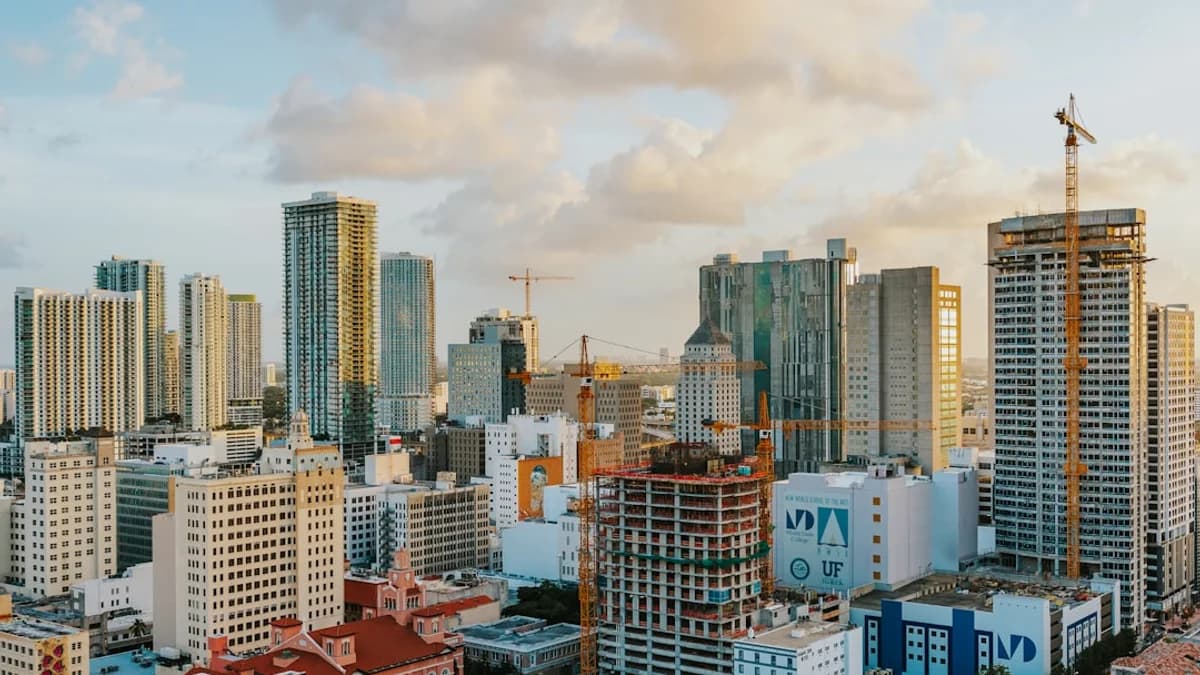
Miami's commercial fire code environment reflects three structural realities that compound each other. First, dense vertical construction — Miami's skyline is one of the most aggressively high-rise metros in the United States, with more active high-rise commercial and residential construction than any other Southeastern city. Second, hurricane exposure — Atlantic hurricane season runs June 1 through November 30, and every high-rise must function through winds that would disable fire protection infrastructure in other climates. Third, regulatory dualism — commercial operators face two distinct AHJs depending on property location: Miami-Dade Fire Rescue for most of the County, and City of Miami Fire-Rescue Fire Prevention Bureau for properties within the City of Miami proper.
Layered on top, Miami operates under Florida Fire Prevention Code 8th Edition (2023) with distinctive county-level provisions. Miami-Dade County Ordinance Sec. 14-69 specifically addresses in-building public safety two-way radio communication enhancement systems — with pre-test inspection protocols, FCC frequency coordination requirements, and specific BDA (Bi-Directional Amplifier) deployment standards. Florida Building Code Section 510 requires emergency responder radio coverage systems for buildings exceeding 50,000 sq ft or classified as high-rise, with 95% in-building signal strength required. The 2026-2027 phased compliance deadlines for existing buildings (per 2023 Florida legislation) are now approaching, creating compliance urgency for high-rise operators who have not yet completed BDA installation.
This guide covers MDFR's Life Safety Operating Permit program, the City of Miami Fire Prevention Bureau, Ordinance 14-69 and the BDA compliance framework, hurricane-season considerations, Fire Alarm System Agent (FASA) card requirements, plans review workflow, and the common violations that catch Miami commercial operators during inspection.
Miami-Dade Fire Rescue —
Fire Prevention Division.
The Miami-Dade Fire Rescue Department Fire Prevention Division is the primary fire code enforcement authority for most of Miami-Dade County, including unincorporated areas and several contracted municipalities.
Headquarters
R. David Paulison Fire Rescue Headquarters9300 NW 41st Street, Miami, FL 33178-2414
Phone: 786-331-5000
Life Safety Operating Permit Program
MDFR operates an annual Life Safety Operating Permit system unique in scope among Florida fire departments. Every commercial and multi-family occupancy within MDFR jurisdiction — excluding single-family and double-family residences — must obtain and renew an annual Life Safety Operating Permit.
Occupancies subject to annual inspection and Operating Permit:
- Commercial office buildings
- Retail and restaurants
- Hotels and hospitality
- Apartment buildings and multi-unit residential
- Townhome complexes
- Hospitals, nursing homes, assisted living facilities, medical centers
- Schools, daycare facilities, educational and recreational centers
- Marinas
- Industrial and warehouse operations
- Assembly occupancies
Inspection workflow
- Fire Safety Specialist I (FSSI) conducts inspection of existing business facilities
- Violations recorded on Fire Inspection Report with applicable codes and required corrections
- 30-day re-inspection window for violation correction
- If corrected: compliance noted, annual Operating Permit mailed to occupant
- If not corrected: Final Notice of Violation issued, case forwarded to Code Compliance Officer until compliance
Inspection requests and scheduling
- Businesses or multi-unit residential buildings may request inspection online via MDFR Fire Inspection Request and Inquiry Form
- Inspection requests before 4 PM are performed the next business day (subject to personnel availability)
- Special Request Inspection (SRI) option: can be scheduled up to 72 hours in advance for additional fee
- Fire inspections conducted in order of priority based on occupancy type
City of Miami Fire-Rescue
Fire Prevention Bureau.
Within City of Miami municipal limits, the Fire Prevention Bureau handles commercial fire code enforcement — operating separately from MDFR (though both enforce the same FFPC 8th Edition baseline).
Fire Prevention Bureau responsibilities:
- Certificate of Use / Fire Safety Permit inspections for commercial properties
- Plans Review for construction and remodeling
- Annual Certificate of Occupancy program monitoring
- Water flow tests and hydrant system monitoring
- Annual life safety inspections of existing businesses, new business applications, marinas, hospitals, and more
For commercial operators: Knowing whether your property falls under MDFR or City of Miami Fire-Rescue jurisdiction is the first compliance question. Properties in unincorporated Miami-Dade County or contracted municipalities (Doral, Miami Lakes, Cutler Bay, Palmetto Bay, Pinecrest, Sunny Isles Beach, among others) fall under MDFR. Properties within the City of Miami boundary fall under City of Miami Fire-Rescue.
Several other Miami-Dade municipalities operate their own fire departments with independent prevention bureaus: Miami Beach, Coral Gables, Hialeah, Homestead, and Key Biscayne among them. Commercial operators with multi-property portfolios across Miami-Dade should verify the specific AHJ for each location.
Ordinance 14-69 —
In-Building Two-Way Radio Communication Enhancement.
Miami-Dade County Ordinance Sec. 14-69 specifically addresses in-building public safety two-way radio communication enhancement systems — a County-level provision that adds to the Florida Fire Prevention Code baseline.
Core framework
Where required by the Florida Fire Prevention Code, the rules and regulations of the State Fire Marshal, or any more stringent fire safety standard of a municipality, or when voluntarily installed, an in-building public safety two-way radio communication enhancement system must be installed, inspected, tested, and maintained in accordance with the policies, procedures, and specifications of the Chief Fire Official.
Critical compliance feature — Pre-Test Inspection Protocol
Under no circumstances should plans be submitted to the Miami-Dade County Fire Department prior to a pre-test inspection. This sequencing is distinctive:
- Pre-test inspection conducted FIRST — MDFR coordinated, initial Received Signal Strength Indicator (RSSI) readings taken
- Plans designed/revised based on pre-test results
- Design professionals may request pre-submittal meeting (discretionary, recommended for complex projects)
- Plans submitted to MDFR with:
- RSSI study showing initial readings
- Completed BDA Checklist
- Any third-party grid test reports (if conducted)
- MDFR review and inspection approval
Plans submitted without pre-test inspection will be automatically disapproved.
FCC frequency coordination
No amplification system capable of operating on frequencies or causing interference on frequencies assigned to Miami-Dade County Fire Department communication (by FCC) shall be installed without prior coordination. This prevents BDA installations that would interfere with fire department operations.
Monitoring requirements
In-building public safety two-way radio enhancement systems must transmit all required supervisory and trouble signals to a central station or to the radio service provider contracted to provide runner service. Continuous monitoring is required.
Inspection request form
MDFR BDA inspection test request form available at miamidade.gov/fire. Key documentation:
- General Contractor information (MDFR verifies)
- Building owner, property manager, or association manager information (MDFR verifies)
- PDF of plans/all floors attached to all pre-test inspection requests
- Third-party preliminary assessment reports (if any) attached
For buildings without a Miami-Dade County permit: MDFR provides a process number after receipt of request form.
Florida Building Code Section 510 —
Emergency Responder Radio Coverage.
Beyond Ordinance 14-69, Florida Building Code Section 510 establishes the technical foundation for emergency responder radio coverage systems applicable statewide — with particular relevance for Miami's dense high-rise commercial base.
Coverage requirement
Buildings exceeding 50,000 sq ft or classified as high-rise must implement emergency responder radio coverage systems achieving 95% in-building signal strength for first responder communications.
Technical framework
- Bi-Directional Amplifiers (BDA) — most common solution
- Distributed Antenna Systems (DAS) — alternative approach for complex buildings
- Alignment with NFPA 1221 and 1225 guidelines for fire department communications
- Florida Building Code 457.1.4.9.3 requires DAQ testing to verify audio clarity and coverage metrics
2026-2027 phased compliance deadlines
Per 2023 bill revisions, Florida established phased compliance deadlines for existing buildings to meet emergency responder radio coverage system requirements. These deadlines fall within 2026-2027 depending on building classification and size.
Miami-specific technical challenges
- Dense concrete construction in Miami high-rises hinders radio signal penetration
- Coastal interference from water and terrain adds signal complications
- Hurricane-rated equipment required for rugged installations that must withstand extreme winds and flooding
- Licensing via MyFloridaLicense ensures qualified installers
For commercial operators of high-rise properties not yet compliant with Florida Building Code Section 510, the 2026-2027 deadlines are approaching. Retrofit planning, vendor selection, and MDFR/City of Miami coordination should be underway now.
Fire Alarm System Agent
(FASA) Card Requirements.
Under MDFR protocols, a Fire Alarm System Agent (FASA) card must be posted at the building entrance during fire alarm inspection and testing, advising of the date and time of the scheduled work.
FASA card purpose
- Informs building occupants of fire alarm work scheduled
- Identifies the authorized agent performing the work
- Required to be posted prior to any fire alarm inspection or testing
- Allows MDFR inspectors to verify authorized work is being conducted
For commercial operators: Building owners and managers should coordinate with their fire alarm contractors to ensure FASA cards are posted in advance of any scheduled inspection or testing. Failure to post FASA cards can result in inspection delays or citations for undocumented work.
New Construction
and Certificate of Occupancy Process.
For commercial construction or substantial renovation in Miami-Dade County, the CO process integrates fire safety as a required gating step.
MDFR new construction workflow:
- Present plans to Miami-Dade Fire Engineering Bureau for project review
- Obtain plans review approval BEFORE construction begins
- Receive Fire Department Application number (10-digit identifier)
- Construction per approved plans
- Pre-inspection requirements:
- Permit card and approved plans on-site during all inspections
- FASA card posted at building entrance (for fire alarm work)
- Outstanding fees paid before inspection request
- Inspection request — permit number, fire application number, or municipal number required
- Final inspections — conducted next business day for requests before 4 PM
- Certificate of Occupancy issuance — after fire safety clearance
Plans status and research
- Miami-Dade Regulatory and Economic Resources Plan Status Portal — check filed permits, permit info, projects under construction
- Portal phone: 786-315-2100
- Microfilm Unit — for original building plans research at 786-315-2340
- Special Request Plans Review (SRI) — expedited plans review available via form submission
For new construction meetings or questions: Call the Captain on duty at MDFR Fire Engineering Bureau.
Common Violations in
Miami Commercial Properties.
MDFR and City of Miami Fire-Rescue most frequently cited violations reflect the unique compliance profile of dense high-rise construction, assembly occupancy density, and hurricane-exposure risk.
1. Missing or deficient emergency responder radio coverage systems — high-rise buildings or buildings exceeding 50,000 sq ft without compliant BDA/DAS systems. 2026-2027 deadlines approaching.
2. Life Safety Operating Permit expiration — annual permits not renewed, resulting in expired operating permits for otherwise-compliant businesses.
3. Hurricane damage documentation gaps — properties that experienced storm exposure without proper damage assessment or remediation records for fire protection systems. Common after any named tropical system.
4. Ordinance 14-69 pre-test inspection failures — BDA plans submitted without required pre-test inspection, resulting in automatic disapproval and delay.
5. Assembly occupancy load posting failures — particularly common in Miami Beach nightclubs, hotels, restaurants, and event venues with variable occupancy.
6. Fire alarm technician contractor verification failures — building owners engaging unlicensed contractors. Florida State Fire Marshal Contractor I-V certification required; building owner cited if contractor lacks current license.
7. FASA card posting failures — fire alarm inspections or testing conducted without required FASA card posted at building entrance.
8. Kitchen hood suppression non-compliance — Miami's massive restaurant base generates consistent violations on 6-month NFPA 96 inspection cycles.
9. Emergency lighting and exit sign battery failures — Florida's heat and humidity accelerate battery degradation; push-to-test verification required to catch silent failures.
10. Storage clearance violations — commercial storage within 18-inch sprinkler deflector clearance. MDFR inspectors use tape measures.
For a comprehensive self-audit checklist, see our fire inspection checklist or download the Florida-specific version.
Hurricane-Season
Compliance Considerations.
Miami's Atlantic hurricane exposure (June 1 - November 30 each year) creates compliance realities no other major Florida metro faces at the same scale.
Pre-season readiness
- Fire protection system functional testing before June 1
- Emergency power system verification
- BDA/DAS system testing (particularly important — communication infrastructure must function through storm events)
- Evacuation planning review
- Hazardous materials inventory review and relocation plans
During and immediately after named storms
- Fire protection system functionality assessment
- Water supply verification (hydrants, standpipes)
- Emergency lighting and exit sign testing
- Alarm system communication verification
- Structural integrity assessment of fire-rated assemblies
Post-storm documentation
- Document any hurricane-related damage to fire protection systems
- Confirm system functionality before reoccupancy
- Coordinate with AHJ on re-inspection if fire-rated assemblies, sprinkler piping, or alarm systems were affected
- Update insurance carriers on any compromised fire protection capacity
Insurance-driven compliance layer
Miami's high catastrophe exposure means commercial property insurance carriers often require fire safety inspections as a condition of coverage or renewal — independent of MDFR or City of Miami inspections. Commercial operators should expect an additional insurance-driven inspection layer on top of AHJ inspections.
Miami compliance questions, answered.
Quick answers to what commercial operators ask most about Miami fire code compliance.
Other city guides in this state
Jacksonville
JFRD · Port + Military + Industrial